
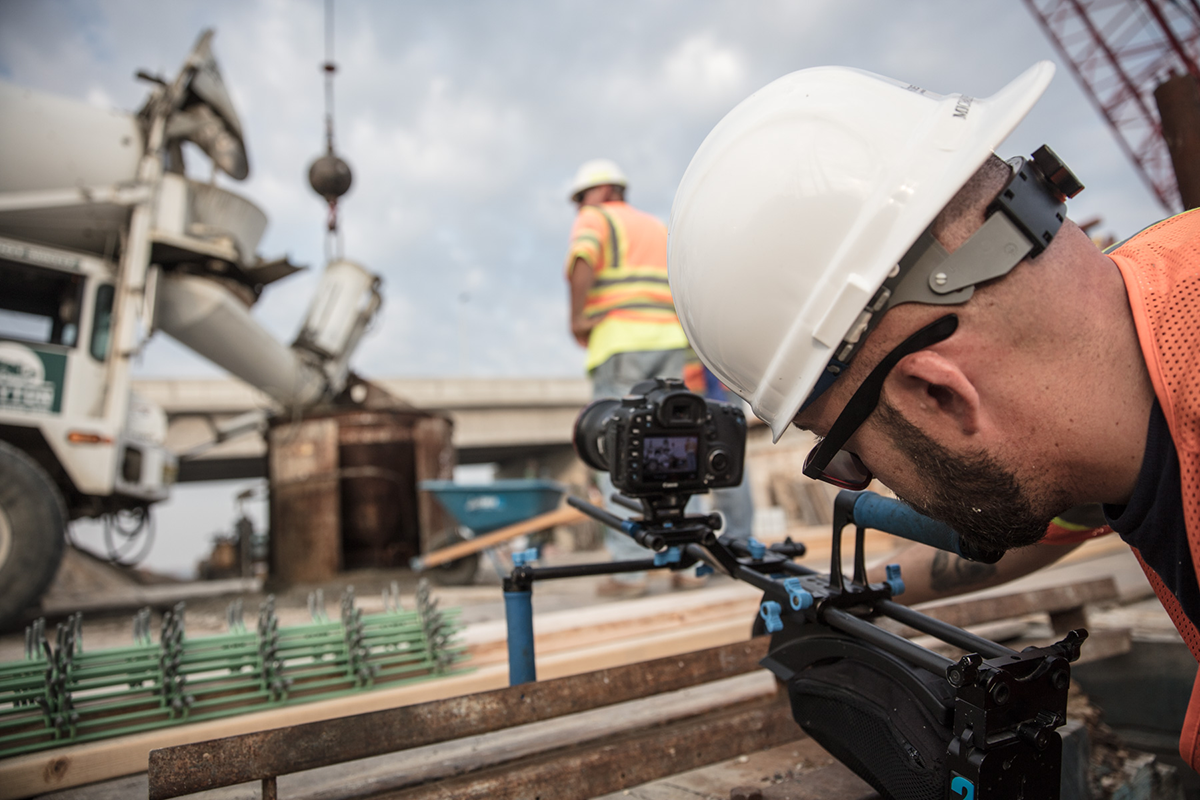
It is National Work Zone Awareness Week—a nationwide campaign running this year from April 21st to 25th, dedicated to raising awareness about safety and mobility in work zones for both motorists and workers.
At Stokes, our team is frequently on-site documenting project progress in active construction zones. Safety—both for our team and for the crews operating around us—is always our top priority. To shed light on how we approach this responsibility, we spoke with Matt Touhey, our VP of Production and Technology, about the careful planning and protocols involved in capturing content within these high-risk environments.
Interviewer: When your team heads into an active work zone, what’s the first priority?
Matt Touhey: Safety, without question. Before any cameras come out or any content is captured, we make sure every team member is briefed, properly equipped, and fully aware of the site-specific protocols. It’s not just about protecting ourselves—it’s about respecting the environment we’re stepping into and the crews we’re working around. That preparation sets the tone forthe entire shoot.
Interviewer: Can you walk me through what happens before your team even sets foot on a work site?
MT: Absolutely. We always attend the required safety orientation first. It’s a site-specific safety briefing that we complete before entering any site.
Interviewer: What kind of personal protective equipment does your team typically wear on-site?
MT: We wear hard hats, safety glasses, high-visibility vests, steel-toe boots, and gloves when needed. That’s our standard PPE for staying safe.
Interviewer: How do you handle working in unfamiliar areas or when someone’s new to the site?
MT: We never work alone. We follow the buddy system, so there’s always someone paired up—either a spotter or someone familiar with the layout.
Interviewer: What kind of limitations or boundaries does your team keep in mind while on-site?
MT: We stay in designated areas only. We don’t enter restricted zones or stray from approved paths unless we’re supervised or have permission.
Interviewer: How do you stay aware of the machinery and moving equipment around the site?
MT: We stay alert and keep our heads on a swivel. There’salways something moving—vehicles, cranes, lifts—so we make sure we’re aware of our surroundings.
Interviewer: What’s your approach when it comes to interacting with crews who are actively working?
MT: We make it a point not to distract them. We never interfere with construction tasks or operators who are focused on their equipment.
Interviewer: How do you manage your gear and equipment, especially when moving through busy areas?
MT: We’re careful with where we place things like tripods or other gear. We keep everything out of walkways to prevent creating tripping hazards.
Interviewer: What role does weather play in how your team approaches the site?
MT: Weather’s a big consideration for us. We’re extra cautious in wet or windy conditions since those can lead to slippery surfaces or falling debris.
Whether we’re documenting progress on a new infrastructure project or capturing the final stages of a build, safety remains at the core of everything we do at Stokes. By combining thorough preparation with on-site awareness, we’re able to deliver high-quality content without compromising the well-being of our team—or the teams we work alongside. As we observe National Work Zone Awareness Week, we’re proud to highlight the people and processes that make our work possible, safely.